Software

Most ERP systems are bloated, complicated, and so hard to implement that people don't bother. We build just what you need, as you need it. So the shop grows into it, and people actually use it.
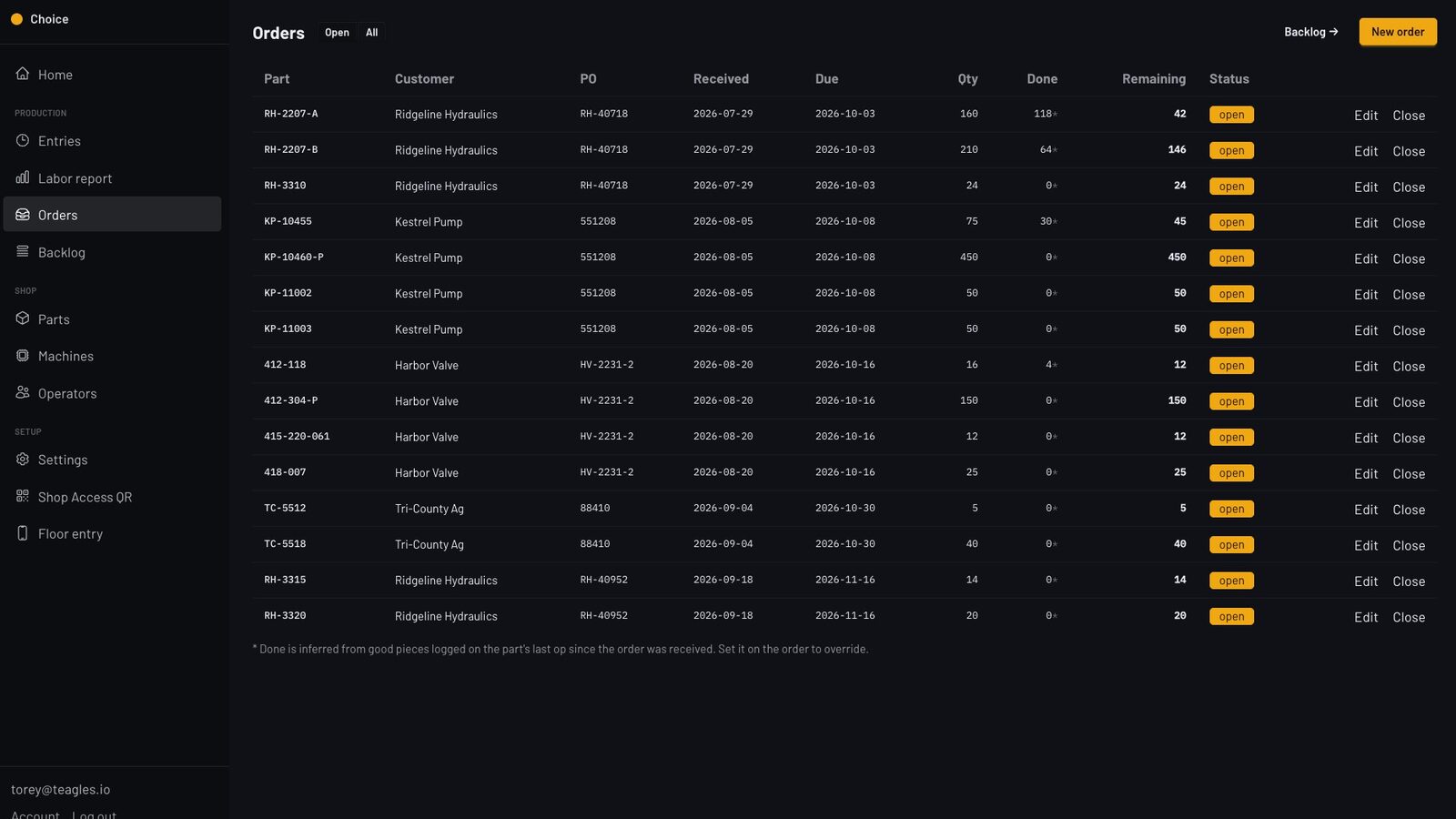
An orders screen in a production tracker we built, with made-up orders

How we build it

It starts with one thing.

Where's the job. What did it cost. Who's clocked in on what. We pick the one that's costing you the most and build that first, the way your shop already works. If something off the shelf would serve you fine, we'll say so.

Every piece sits on the same base.

The second conversation usually sounds like "what we really need is something to manage the whole operation." That's fine. Every piece we build sits on the same base, so the fifth thing costs less than the first.

It's yours, and it's called what it does.

Your tracking software, your scheduling software, until you give it a name of your own. Torey came out of tool and die and fabrication before he wrote software, so we'd rather walk your floor and see how work actually moves, from the quote to the shipping dock, than show you a demo.

We do the setup.

We move your data over and set it up with the person who knows how the work runs today. After it's in, they're still the one who knows how it works; they just stop typing the same thing twice.

You can always leave.

Your data is yours. Before you sign, we put the exit terms in writing: what you take with you, in what format, and who could pick it up after us. We'd rather you stay because it's worth it.

More ways we help

Workflow Automation

Those tasks everyone hates but nobody questions? We find them and take the monotony out of them.

We spend time in your shop, learn how work actually moves through it, and pick out four or five tasks that are strong candidates: data entry that could fill itself in, reports that could run overnight, approvals that could take one tap instead of three emails. Then we build the automations, with whatever will still be running a year from now.

QuickBooks

Torey is a Certified QuickBooks ProAdvisor, which means Intuit has tested him on QuickBooks Online setup and best practices.

New to QuickBooks, or moving from another system? We set it up right from the start: chart of accounts, payroll, invoicing, and reporting. Already on it but not getting the answers you need? We clean up the data, build the reports that matter, and connect it to the rest of how your shop runs, so the same numbers don't get typed in twice.

Document Scanning

If you're running on paper timecards and paper logs, we don't scan them; we turn them into a workflow that's better than the paper.

The paper you need to keep, we make searchable. Each page gets read, the document type, date, customer, and job number get pulled out, and your team can find that invoice from 2018 in seconds, from any device.

Continuous Improvement

A scheduled session every month, for a year, to work on the next thing on the list. Not an emergency call.

Each month we take the next frustration and fix it, and the fixes add up. Every month has to be worth every penny; that's the standard we hold ourselves to.

Work

Software we built that shops run on every day.

Agritek Industries

It started as a time clock. It grew, one piece at a time, into labor tracked against the work, project costing, and capacity reporting across five facilities.

Past work

Broadview Product Development

We built Broadview's online ordering for custom 3D printed parts, with real-time pricing. Their team quoted jobs in the same tool their customers ordered through.

Past work

Canvas Innovations

We mapped how Canvas Innovations' sales and production actually worked, then moved it off paper.

How it starts

Small first. The next thing comes after the first one works.

  1. 1

    Let's talk

    Free

    An hour or two, at your shop or on a call. We talk through what's getting in the way.

  2. 2

    Discovery

    $500, up to $1,000 for a bigger project

    We start building the solution. At the end you know whether it's feasible and what it will actually cost.

  3. 3

    Build

    Quoted

    Priced from what discovery found. Small first; the next thing comes after the first one works.

Most first engagements start small, $1,500 to $3,000, and large projects can grow to $20,000 and up. $150/hr when it's hourly. We build in-house, and bring in partner developers when a project calls for it.

What's the one thing costing you the most?

Start there. We'll spend an hour or two on it with you, free.